

a pedagogical showdown: explicit vs inquiry
If you sit on the fence for too long, you'll get splinters.

I’ve just gotten back home from Straddie (Stradbroke Island, which is a stunning island just off the coast of Brisbane, for those not familiar), after spending a good portion of the last few days either on the sand with a book and my dog, Pippa, or in the ocean. I’ve returned refreshed, a little sun-kissed and with very sore legs after tackling an absurd number of stairs.
No, really. It was absurd1.

The staircase above, which has ~250 stairs according to some strangers on the internet2, leads down to Frenchman’s Beach. In a lapse of judgment about my own relative fitness, I started the walk down to the beach. I got part-way down and only then decided to look at the number of remaining stairs, which resulted in a horrifying realisation: there were lots of them. At this point though, it seemed silly to go part-way and then stop. Why only do something by halves3?
So, I committed to the bit and walked down to the beach.

Why am I telling you this? Because it would have been just as easy for me to stop halfway, change the plan and go back up the stairs. I’d have still had a beautiful view of the beach, still gotten in some steps and still been able to say I’d been for a lovely morning walk; however, I wouldn’t have gotten the full benefits of making it all the way down to the beach. Some things aren’t designed to be done halfway. They only work as intended when you follow them through.
You know, like explicit instruction.
explicit instruction has a place: the classroom
I’ve addressed this recently, but there’s been a shift in the criticisms4 of explicit instruction that have moved to something similar to the following:
“Explicit instruction has a place.”
Yeah, it does. The classroom.
This stance is one where the explicit instruction critic acknowledges that explicit instruction is sometimes effective, often by stating it’s great for developing procedural knowledge in novices. This argument usually goes on to say that it doesn’t help develop conceptual understanding or problem-solving skills, before arriving at a collection of vaguely defined claims about “real world” learning or “holistic” education.
Often the argument can be summed up as the following very-broad pedagogical sequence:
Explicitly instruct
Let students inquire so they become masterful problem-solvers.
Now I’m sure some people might say that I’m oversimplifying the sequence, and I am. Perhaps, the argument is that there is more of a continuum from explicit instruction into inquiry - you know, something of a gradual release of responsibility.
Whoa. Hold the front door. Isn’t that just explicit instruction?
Because if we were to consider what myself, and my other science of learning pals5, were referring to as ‘explicit instruction’, that entire sequence is built on a combination of instructional techniques that gradually release responsibility to the learner such that they can independently problem-solve.
So to summarise, these critics are really arguing for explicit instruction, and we should all go home now. However, if you still want to go in for a pedagogical showdown, please saddle up. We ride at dawn.

they mean well; they’re just confused
The confusion seems to come from an annoyingly persistent conflation of ‘explicit instruction’ with ‘modelling’. That is, some people still think that explicit instruction = lecturing. Gee, I was once very guilty of this. Let’s flash back to my initial teaching degree days, where I made the following two (what I would now describe as incorrect) statements in assignments for my teaching degree:
“It should be noted that explicit instruction should not be the sole teaching style. Students respond to a variety of pedagogical strategies, including inquiry learning.”
“Several studies showed that explicit instruction is highly effective at improving student outcomes. This is important when teaching foundational content to students6.”
Yikes. Someone go back in time and scare young me by showing her these posts pls.
I was commended for that section in my paper by the lecturer marking it, rather than called out for my obvious conflation of modelling and explicit instruction. Perhaps this lecturer didn’t know the difference between the two themselves and so couldn’t correct my misconception.
It’s not surprising then that this view still permeates all of the social channels we use to have our pedagogical battles, so to speak.
To make sure we’re on the same page, let’s do some brief definitions here then.
Explicit instruction:
“…the defining feature of explicit instruction is that, for novice learners, concepts are fully explained, and procedures are fully modelled before learners are asked to apply those concepts or procedures. Significantly, this working definition does not preclude the possibility of learners completing open-ended problem-solving tasks.” - Sweller, Zhang, Ashman, Cobern, & Kirschner (2024)
Typically, guidance around effective explicit instruction would go further to stipulate that tasks should be broken down into small steps and students should be given several opportunities for practice, including independent practice. Take the following from Rosenshine’s Principles of Instruction (2012), for instance:
“Present new material in small steps with student practice after each step.”
“Ask a large number of questions and check the responses of all students.”
“Require and monitor independent practice.”
In fact, that active involvement of students practicing after each step, embedded formative assessment and responsive teaching are all what form an explicit instruction lesson, and draw it distinctly away from purely lecturing at a group of students. Previously, in my post on explicit instruction, I included the following image that highlights that the majority of lesson time is spent asking students questions and responding to that data:
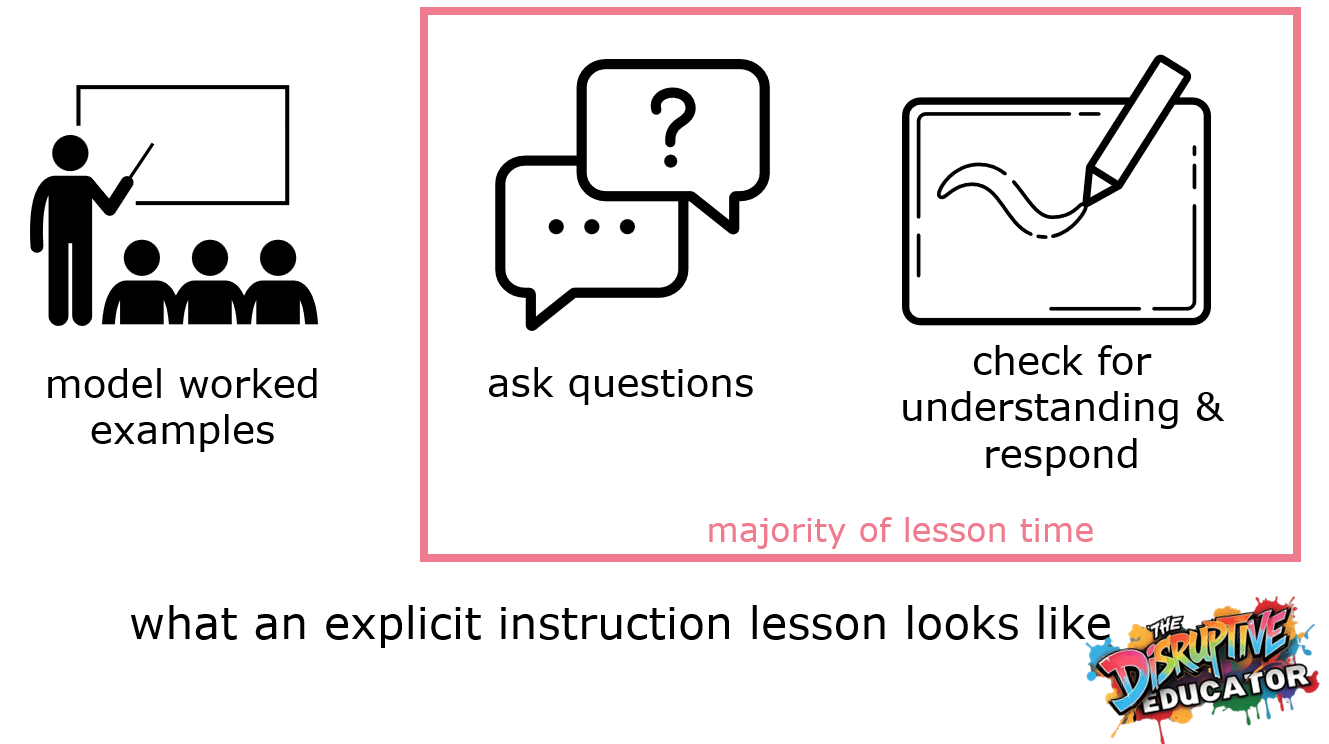
Further underpinning explicit instruction is the gradual release of responsibility7. Gradual release of responsibility can be defined as follows:
“an approach to teaching that emphasizes a gradual shift in responsibility from the teacher to the student. For example, whereas a teacher may take most or all of the responsibility in guiding students through a complex and/or new task…, the goal of [gradual release of responsibility] is to guide students toward an increasing level of independence in completing the task” - Salehomoum, Revelle, Duke, & Pearson (2022)
Essentially, it’s the gradual transition from fully guided practice to independent practice. Just to make mention of the role of gradual release of responsibility within an explicit instruction framework, please see below from the NSW Department of Education, for instance:
“Gradual release of responsibility is an explicit teaching strategy. It is not linear as teachers move between modelling, guided and independent practice throughout lessons. Teachers make decisions based on student understanding and readiness. Students may move 'forwards' and 'backwards' in this process.” - NSW Department of Education
Importantly here, the reference to the fact this movement isn’t necessarily linear draws upon the formative assessment and responsive teaching elements of an explicit teaching instructional sequence, mentioned above.
To summarise, this means that explicit instruction is not a component of a lesson. It is the lesson. Or rather, I might describe it as being the entire sequence of instruction that’s used within a lesson, underpinned by the science of learning, whereby the teacher explicitly models all relevant concepts to students. This means that explicit instruction isn’t something that I can just do for 15 or 20 minutes of my lesson time. It is my entire lesson.
Modelling:
Modelling, or explicit modelling, is part of the explicit instruction sequence. Modelling is the teacher-led demonstration of a skill or concept before students need to attempt this themselves. This involves breaking tasks down into manageable steps, using worked examples, providing examples and non-examples, and ‘think-alouds’ during demonstrations, to name a few techniques. This publication explains this idea well.

This involves explicitly demonstrating or telling students what you want them to know. In the words of Zach Groshell:
“Just Tell Them” - from the title of his book ‘Just Tell Them: The Power of Explanations and Explicit Teaching’
Modelling is an important part of the explicit instruction sequence. In fact, it’s the key defining factor; however, it’s not the only piece to explicit instruction. Going back to my own image above, it’s just one very small portion - one that must be present, but it’s not the whole show itself.
the difference
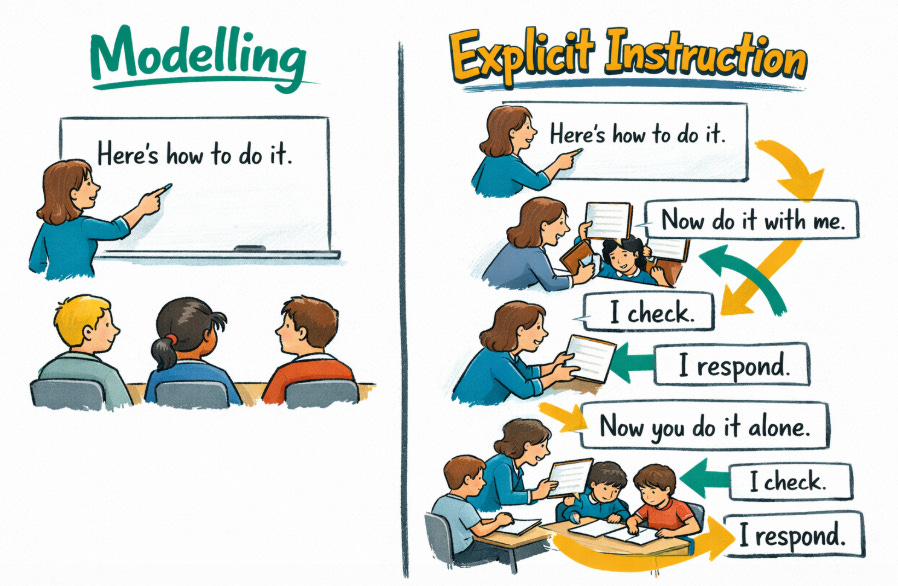
Modelling:
“Here’s how to do it.”
Explicit instruction:
“Here’s how to do it.”, followed by a series of steps to gradually release responsibility based on formative assessment of student mastery.
¿porque no los dos?
Why not both? Why not have explicit instruction and inquiry in the one lesson?
Explicit instruction is the whole instructional sequence. Inquiry is the whole instructional sequence. And you can’t have two wholes8.
This is where it comes back to definitions. With the definition above of explicit instruction, the goal is to move students gradually through stages of learning to get them to a point where they can complete independent practice and move into non-routine problem-solving. Some might describe this end ‘portion’ of an explicit instruction sequence as being inquiry, and that’s fine. In fact, if we’re referring to inquiry as being purely something students can pick up and do, I’m totally on board with that. The idea of transitioning students into being able to generalise and adapt knowledge is literally part of The Instructional Hierarchy:
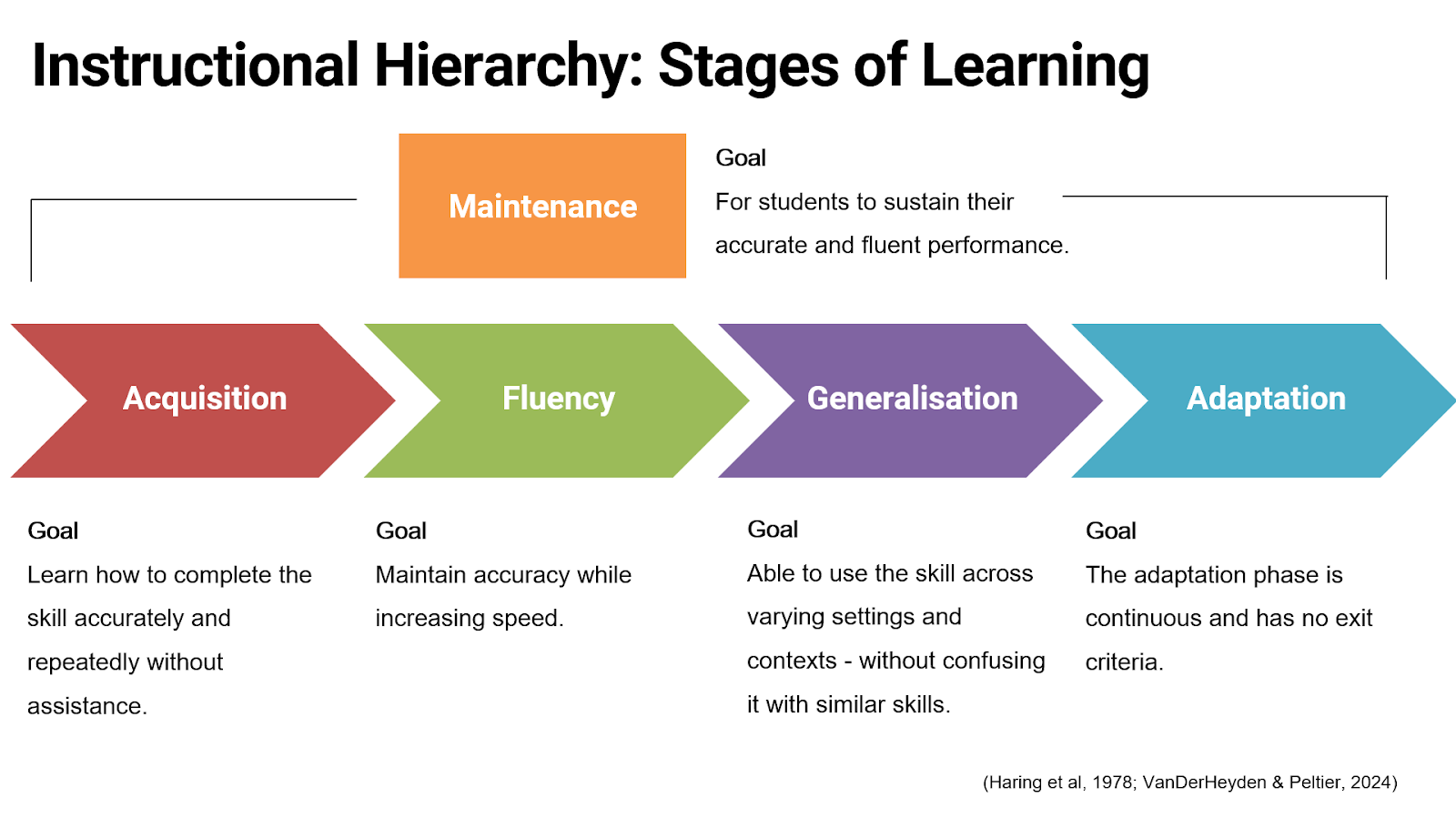
In that case, it’s really just semantics, right? If we’re all arguing that lessons should involve explicit modelling of all core concepts, opportunities for practice, faded guidance, regular whole-class checks for understanding, responsive teaching and a gradual release of responsibility with the aim being to move students towards independent work, then hoorah! We’re all fighting for the same thing and our pedagogical standoff is over. Honestly, call that technique whatever you want, because I don’t even care about the title if you’re just going to teach effectively.
However, this doesn’t seem to be the point being made in many of these mysterious unnamed internet posts I see that are trying to discredit explicit instruction. These posts typically focus on the idea of having ‘explicit modelling’ elements within inquiry lessons, removing the features that make an explicit instruction sequence so effective. Nathaniel Swain makes reference to this point exactly:
“if we are embedding the explicit part somewhere in the mix of an inquiry or problem solving mode of teaching (no matter how clearly we try to do this), I would argue this does not constitute the “explicit instruction” that aligns well with the science of how students learn.” - Inquiry learning or explicit teaching - balance, Dr Nathaniel Swain
I agree. An inquiry lesson cannot contain ‘explicit instruction’ portions. It may contain explicit modelling, or it may contain multiple opportunities for practice; however, these two teaching methodologies are inherently different. The phrases ‘explicit instruction’ or ‘inquiry learning’ are used to describe two different pedagogical sequences, not just individual strategies that can be picked up and used as one may please - although both contain several strategies. With these definitions, it means that elements of each cannot sit within the other.
fence-sitting
Don’t sit on the fence too long or you’ll get splinters. I didn’t make that quote up, but I did think I did when I was on a stair-less walk thinking about this post. Turns out a lot of people have had bad experiences having been sat on a fence, which honestly just strengthens my point that you probably shouldn’t do it.
It sounds nice to sit on the fence and argue that a lesson needs variety. To be honest, I agree that lessons need variety, but I suspect what we define as variety might differ slightly. For instance, lesson variety could mean a little bit of voice modulation throughout, or covering new concepts each day, or even bringing in a totally different creative, but probably ineffective, learning experience each day so that students never have to learn about fractions by seeing an actual fraction9. Likewise, we could definitely describe making rumballs in class to teach Business Management as lesson variety:
“What student wouldn’t think about smashing biscuits or mixing in condenses milk and say to themselves ‘oh yes, this is a process to transform our inputs to our final output, just like what Mr Brien taught us last week’? Turns out all of them wouldn’t think that.” - Shaun Brien, Ghosts of Lessons Past Pt 3
However, as Shaun very clearly stipulates above, not all variety is effective variety, no matter how delicious.
Variety sounds like one of those things you need. It’s an appealing concept, so it’s hard to argue against, which is what makes fence sitting so easy. When you consider how responsive teaching works though, it’s hard to argue that there’s not variety in that lesson structure. You’re literally adapting your lesson in the moment to what you’re seeing. It’s so much variety that even the teacher doesn’t know exactly how their lesson will go.
Personally, I also find students get plenty of variety when you just teach them new content well every day. This is something easy to do when you teach them well in the first place. You know, learning can be engaging10, and even more so when that learning has been effective. Our job isn’t to come up with a new way of presenting learning to students each day or changing our lesson structure each period for the sake of it. It’s to teach well.
Part of the fence-sitting side here that argues for bits of both explicit instruction and inquiry learning tries to draw upon supposed limitations of explicit instruction. It relies on claims that students need to be able to produce knowledge independently, problem-solve and develop the ability to adapt their knowledge for the real world - and of course we can’t argue with that. It’s right. However, those aren’t arguments against explicit instruction. Those are exactly what explicit instruction, and specifically gradual release of responsibility, works towards. The whole purpose of explicit instruction is to provide the most efficient and effective guidance to move students from novice learners into experts who can adapt their knowledge across contexts. You don’t get that outcome by doing a bit of everything or changing techniques part-way through. You get that by sticking with the full sequence.
a pedagogical showdown?
I spoke at the beginning about making my way down an absurd number of stairs at Straddie over the weekend, and how I would not have experienced the full benefits of doing so had I stopped part-way and turned back.
This is not dissimilar to what happens when only portions of an explicit instruction sequence are taken and used - often just modelling alone. Without the opportunities for practice, formative assessment, responsive teaching, gradual release of responsibility and everything else that makes up the explicit instruction sequence, individual strategies will only get you so far. It’s like stopping part-way down the stairs and never actually making it to the beach. The power of the explicit instruction sequence is the culmination of everything altogether.
So, is this really a pedagogical showdown? A battle of explicit instruction versus inquiry learning?
Because if we’re all aiming for students who can apply knowledge independently, solve problems and adapt their knowledge, then we’re not arguing for different outcomes. We are, however, arguing about how to get there.
And on that point, I’d argue that inquiry learning and explicit instruction are fundamentally at odds. Not because one values independent practice and the other doesn’t, but because they represent entirely different instructional approaches. Neither approach is just a collection of strategies or techniques that can be slapped together however one pleases. On both ‘sides’, there exists a best practice that outlines how individual decisions and strategies are sequenced, and why this is done. This means that under these definitions they can’t really be blended and they can’t coexist in the same lesson.
To say that ‘best practice inquiry’ contains some explicit instruction just cannot be the case, when explicit instruction is the entire sequence.
In some ways, yes, this is a pedagogical showdown. Just it’s not a battle of preferred outcomes; it’s a clash of approaches. Specifically, it’s a difference in how we think learning happens and how we choose to get students there, and those cannot coexist in the same lesson.
And in case you were wondering which side I would take, I’d follow the staircase all the way down to explicit instruction. Every time.

Or perhaps I’m just unfit
One internet person did say 500 stairs, which felt accurate to me, but I suspect was an exaggeration.
The answer is so that your legs don’t spend the next few days paying for it.
As always, not here to attack individuals, only arguments, but with about 2 minutes of your time, a LinkedIn account and a quick search, you should be able to find examples easily.
Here’s some links:
Jamie Clark - Explicit Instruction: An 8-Step Lesson Sequence for High Impact Teaching
Peps McCrea - Evidence Snacks - Explicit Teaching
AERO - Explicit instruction optimises learning
Greg Ashman, in one of many publications referencing this idea, so I took an older one to show it’s not new - Explicit teaching is highly interactive
If it’s so effective, why not the sole style? Why only foundational content? Maybe Young Teacher Caiti was sneakily touching on expertise reversal effect without even knowing it.
How many holes does a straw have?
Please don’t do this if you actually want your students to learn fractions.
If you’ve stuck with my footnotes this long, you get a spoiler here! New collab post on engagement coming soon… stay tuned.
Love your work Caiti. Like you, I was a straddler, learning styles, shake it up variety teacher for many years. Then I learned about effective instruction in literacy - specifically writing. The teaching and learning cycle (aka gradual release of responsibility, I do, We Do, You do) says at the cure of what I do and what I bring to coaching conversations.
For a while, time constraints led me to jump from detailed modelling and annotated samples, straight to ‘I’ve shown you, now it’s your turn, kids!’ Then wondered what was missing. Now, I reinforce the importance of the joint construction phase- we do - as the essential bridge between being shown and doing.
Variety comes through the many ways each phase can be constructed. Responsive teaching through formative assessment and ensuring all elements of the cycle are present is what leads to achievement. And success leads to better engagement when students are more willing to try after feeling they CAN, that knowing how is no longer a mystery.
As a preservice teacher recently going through ITE, I personally feel there is much less of a showdown nowadays. Explicit teaching was definitely included in my course. Education departments are recommending and or mandating the approach. It may still take some years to flow through the system but it is definitely going in the right direction, from my perspective anyway. Thanks, Adrian