

why i don't like 'differentiation'
And why we need to redefine it around equitable access, not alternative tasks.

There are few words in education that evoke a stronger reaction in me than ‘differentiation’. Don’t get me wrong, I am wholeheartedly in favour of supporting all students to succeed. But the term ‘differentiation’, as it is commonly used, has come to make me uncomfortable. Not because I oppose its purpose, but because I care about it deeply. A concept that should be grounded in equity for all students has somewhere along the way come to be stretched, distorted and redefined to the point where it often results in the exact opposite: different tasks, different content or even different expectations for different students.
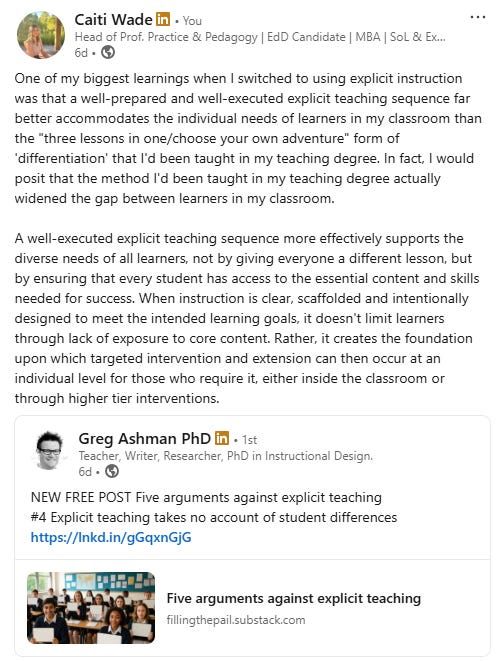
Greg Ashman recently posted this blog (which I would encourage you to read if you have not already done so) challenging the myth that explicit instruction does not address individual needs of students. The myth rests on the idea that whole-class explicit instruction is a “one-size-fits-all” approach that doesn’t accommodate the needs of individuals in a class, whilst differentiation, which is often interpreted as providing different tasks to students, is the key to supporting all students.
I shared a short reflection on this topic on LinkedIn, and from some of the discussions that arose both on and offline following this, it got me thinking more deeply about differentiation. It became clear that while we all want to meet the needs of diverse learners, there are very different interpretations of what differentiation actually is, and what it should look like in a classroom grounded in evidence-informed practice.
This highlighted a fundamental issue:
We keep debating differentiation without agreeing on what the word actually means.
Until we clarify this, we risk talking past one another, or worse - adopting practices that undermine the very purpose of differentiation.
the purpose of differentiation
Before we discuss what differentiation looks like or how it should be implemented, we need to be clear on why it exists. I would argue:
The purpose of differentiation is to ensure that every student has access to, and is supported to achieve success in, the core curriculum.
Put simply, the aim of differentiation is to ensure equitable access to the core curriculum objectives for all of our learners. Its core function is to remove barriers and put in place strategies to facilitate students accessing essential knowledge and skills.
As The Department of Education puts it, “effective differentiation supports all students to achieve learning growth, regardless of their starting point”. I think you would be hard-pressed to find an educator who disagrees with that intention.
With this purpose in mind, the real question, then, is not whether we should differentiate, but how we do so in a way that upholds this purpose.
from access to alternatives
So let’s start with what I’d argue is the commonly referenced implementation of ‘differentiation’ and the reason the term causes me such unease.
It probably won’t surprise you to hear that when I did my teaching degree, there was a huge focus on differentiation. The general message was that in each lesson, the teacher should provide different tasks or different modes of completing tasks, based on the perceived abilities or preferences of students in the class. In every unit and lesson plan I submitted, I was expected to include two or three alternative activities to “cater to different ability levels”.
This isn’t an isolated experience. Across initial teacher education, professional development, and even departmental practice guides, differentiation is commonly presented as students working on different content, different tasks, or different levels of the curriculum within the same classroom.
But here’s where the issue emerges: if the purpose of differentiation is to ensure that every student is supported to access and experience success with the core curriculum, how does sending students off to do different activities achieve that?
the choose your own adventure trap
In many classrooms - including my own in my early career - differentiation is implemented by designing two, three, or even more different tasks within a single lesson, with students directed to the activity that matches their ‘ability level’ (whatever that means). I refer to this as the choose your own adventure model of differentiation. Instead of one carefully sequenced pathway through the curriculum, students are sent down different learning tracks, each with its own content, its own level of complexity, and often, its own destination.
The most obvious problem with this model is that the alternative tasks often do not lead all students to the same learning objective. In my early years of teaching, I frequently gave “easier” tasks to students who struggled, believing I was meeting them at their points of need. In reality, I was reducing their access to core curriculum content. When assessment time came, these students were underprepared - not because they were incapable, but because they had never been given the opportunity to learn the concepts they were expected to know. I wasn’t supporting equitable curriculum access - I was blocking it.
The students who most needed access to complex content were the very ones I was withholding it from. This wasn’t simply a matter of lowered expectations; it was, in hindsight, an ethical disservice to my students. I had unintentionally contributed to widening the achievement gap, not because my students were incapable, but because the structure of my lesson prevented them from even engaging with the knowledge they were entitled to.
And this is the heart of the problem:
Differentiation shifted from being about access to the curriculum to being about alternatives to it.
so do i differentiate now?
Absolutely, but probably not in the way many of us were taught to.
To go back to the purpose of differentiation being providing equitable access to the same curriculum, we can shift our focus to how we support diverse learners to be able to access and acquire that curriculum. The answer lies not in student preference or varying tasks, but in how the novice brain learns new ‘academic’ (read: biologically secondary) information, which it turns out doesn’t differ all that much between novice learners. That would suggest that a ‘one-size-fits-all’ instructional approach isn’t too far from the truth, for the most part.
The first and most powerful way of ensuring equitable access to the core content is strong Tier 1 instruction. Our primary focus must be on designing whole-class instruction that enables most, if not, all of our students to access that curriculum successfully in the first instance. Cognitive science research demonstrates that novices benefit most from fully guided instruction or, in other words, well-sequenced explicit instruction. When the initial instruction is effective, the need for individual intervention decreases. In fact, the best intervention we have is good instruction.
adjust the process, not the expectations
So how does ‘differentiation’ look in an explicit instruction classroom?
Firstly, high-quality explicit instruction should be grounded in clear core learning objectives and an intentionally-sequenced progression that builds knowledge gradually and deliberately. As Carl Hendrick says:
“Good instruction prevents errors instead of correcting them.”
This requires pre-empting misconceptions, designing scaffolds, and giving students frequent opportunities for supported practice. This does not mean errors won’t happen, but it decreases the frequency with which this happens.
The next method is responsive teaching. As often as possible, and easily over 100 times in a 70-minute lesson, the teacher should be checking for understanding. These checks aren’t about formal assessment. They’re about gathering real-time data to inform instructional decisions - adjusting the pace either faster or slower, reteaching as needed or extending students where appropriate. This is the main way that as a teacher I would tailor my teaching to the needs of the individuals in my room, because I’m constantly adapting or responding at their point of need.
For example, I often speak to times when I have taught what would be typically referred to as the ‘lower ability’ (for simplicity, though not a label I would endorse) classes in mathematics and have moved them onto extension material within a lesson. This didn’t happen because their ‘ability’ suddenly changed. It happened because clear, responsive explicit instruction removed the barriers that had previously been mistaken for fixed ability. And more to the point, is something that would not have happened had I not been able to see that they had mastered the core content for the lesson through frequent checks for understanding.
what if they still don’t get it?
Albeit rare for me these days, there are occasions where a student doesn’t grasp a concept immediately. The key is that this is identified in the moment through checks for understanding, rather than being discovered a week later on an assessment.
When this happens, I assign the rest of my class a 2-3 minute independent practice task - which I am confident they can do at this point in the lesson. In this time, I provide a brief targeted intervention with this student. This is efficient because typically speaking, at this point, I’ve identified what the cause for their difficulty is through my checks for understanding, and I address it directly with them. Then I return to whole-class teaching.
Of course, there will be cases where, often for factors well outside of the classroom, students do require additional intervention at a Tier 2 or 3 level; however, individualised support should not have to compensate for weak initial instruction.
When Tier 1 instruction is deliberately designed to be fully guided, build knowledge and skills gradually and respond in real-time to student understanding, the number of students needing individual support decreases significantly. In other words, intervention should be the exception, not the plan. The goal of effective differentiation is to get instruction right the first time, so we’re not constantly trying to patch over gaps that were created by less-effective initial teaching, and to ensure that our Tier 2 or 3 interventions have the foundations to be effective.
reclaiming ‘differentiation’
So that’s why I don’t like the word ‘differentiation’. Not because I reject its purpose, but because of what it has come to mean in practice.
Differentiation was never meant to be about providing alternatives. It was meant to guarantee access to it. Our greatest tool for equity isn’t more pathways; it’s better instruction.
Any thoughts on UDL?
I’ve usually seen differentiation applied as a term about how to engage higher-ability learners, not struggling ones. How do you keep the top 10-20% of your class engaged in this model?